How My Manhattan Project (MMP), and the three installations that make up the Project, “showed up”.
The first. ‘skin’
Sometime in the late 1990s I was invited to create an installation in the main gallery of the Loveland Museum/Gallery in Loveland, Colorado by Dr. Janice Currier, curator of exhibitions for the museum.
No organizing theme was presented, no request for a particular kind of work, just an invitation. An expression of trust in my work by Dr. Currier and the LM/G for which I am forever grateful, as the invitation resulted in the first installation of MMP called ‘skin‘ – though, at the time MMP wasn’t even a twinkle in my eye.

The subject I was exploring in ‘skin’ arose during a soak in an old clawfoot tub that sat in our tiny bathroom, oddly located off the kitchen of our house in Loveland.
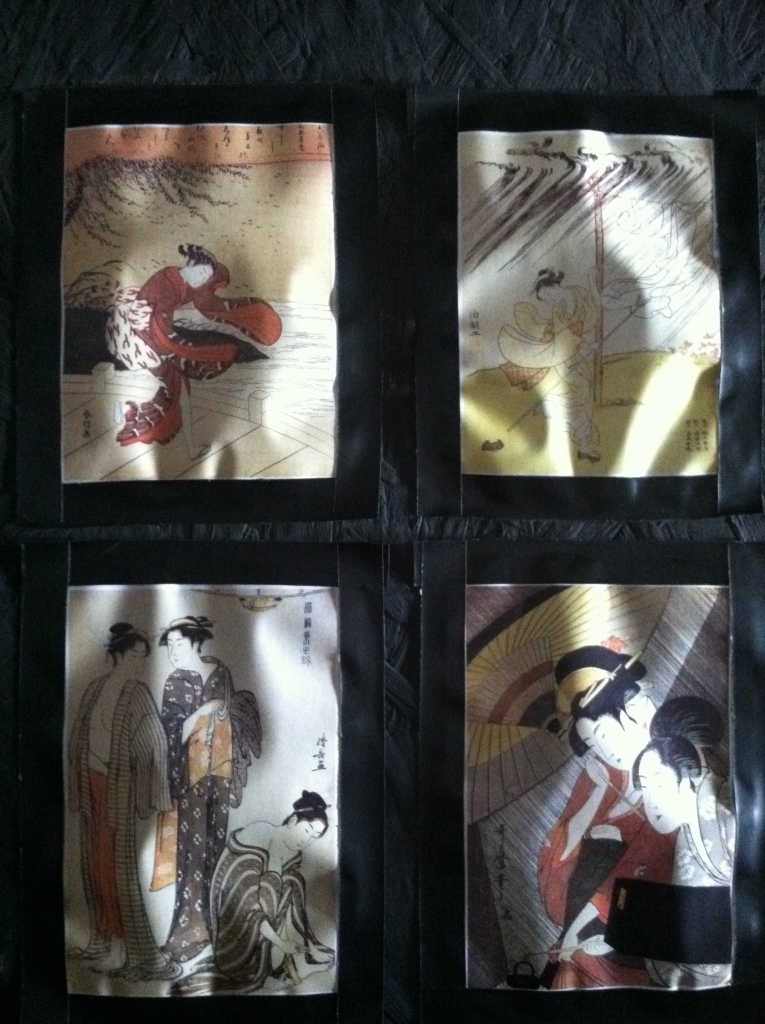
Antique Japanese woodblock prints
Soaking in a tub of hot water remains one of my very favorite things to do. Because it’s relaxing, yes. But, it turns out, it’s also stimulating, because that relaxation has allowed for what I now call downloads to happen – ideas, many times in fully formed pictures, appearing in my head, of artworks waiting patiently to be made.

This particular time I was quietly sitting in my tub, gazing at some gift card images of old Japanese woodblock prints that I had framed in cheap plexiglass boxes and hung on the wall.
The images were two scenes of young girls caught in rain showers, one of a geisha and her assistant, again, caught in a rain shower, and an image of three women in the bath. All lovey – and none having anything to do with anything atomic. Yet, as I gazed at them my mind went to wondering about how awful it must of have been for those who died, and more so lived through, the atomic bombings of Hiroshima and Nagasaki.
Four images of old Japanese woodblock prints. All created centuries ago in a country I knew little about, but were now strangely inspiring me while soaking in my tub – becoming the catalyst for my creating an installation called ‘skin‘.
In ‘skin’ I contrasted and compared events about our war with Imperial Japan (WWII) that ended in the dawning of our atomic age. It was about a war waged far into a future beyond the time the woodblock prints were originally created, yet, here they were, telling me what I needed to do.
“they sang before the dawn…”
‘skin‘, referenced in the installation “they sang before the dawn…”.
Fast forward to 2012. Again I’m sitting in a clawfoot tub. Only this time it’s during the opening of the Love & Light Show in Loveland’s Feed & Grain building, in below freezing temperatures – a heating pad the only thing between me and frozen bones. As I sat in the tub greeting visitors to the exhibition, I was again gazing at images of the four gift cards from my bathroom – copies now tacked to a distant wall of this old building, softly lit, reminding me of their power to inspire.
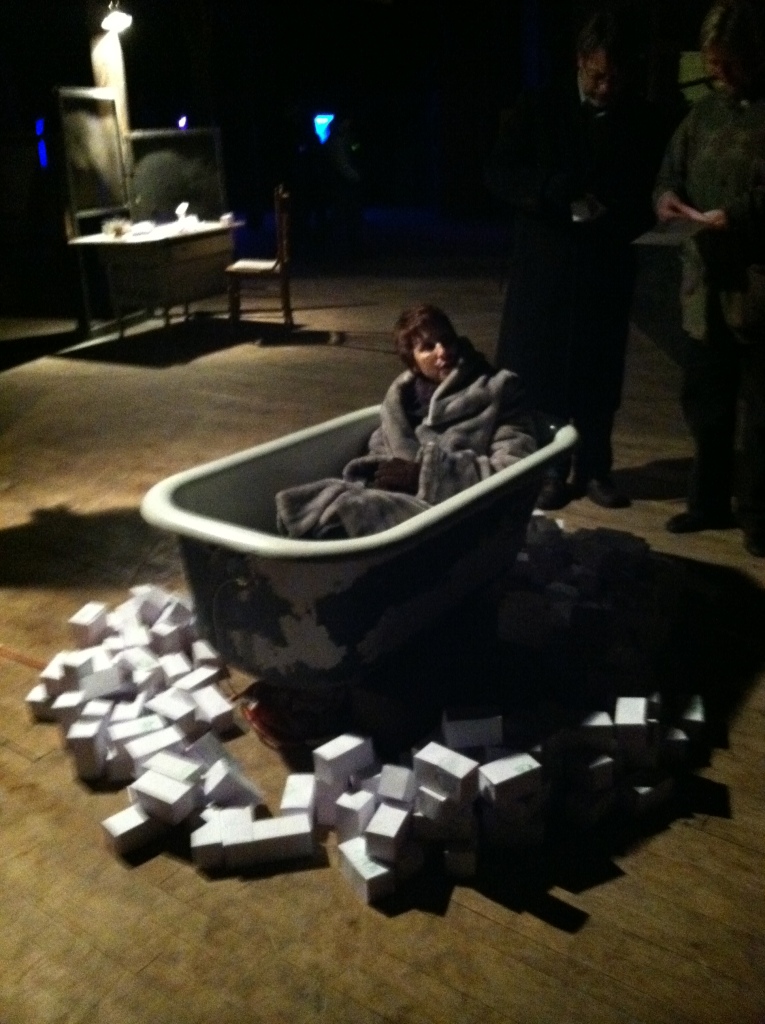
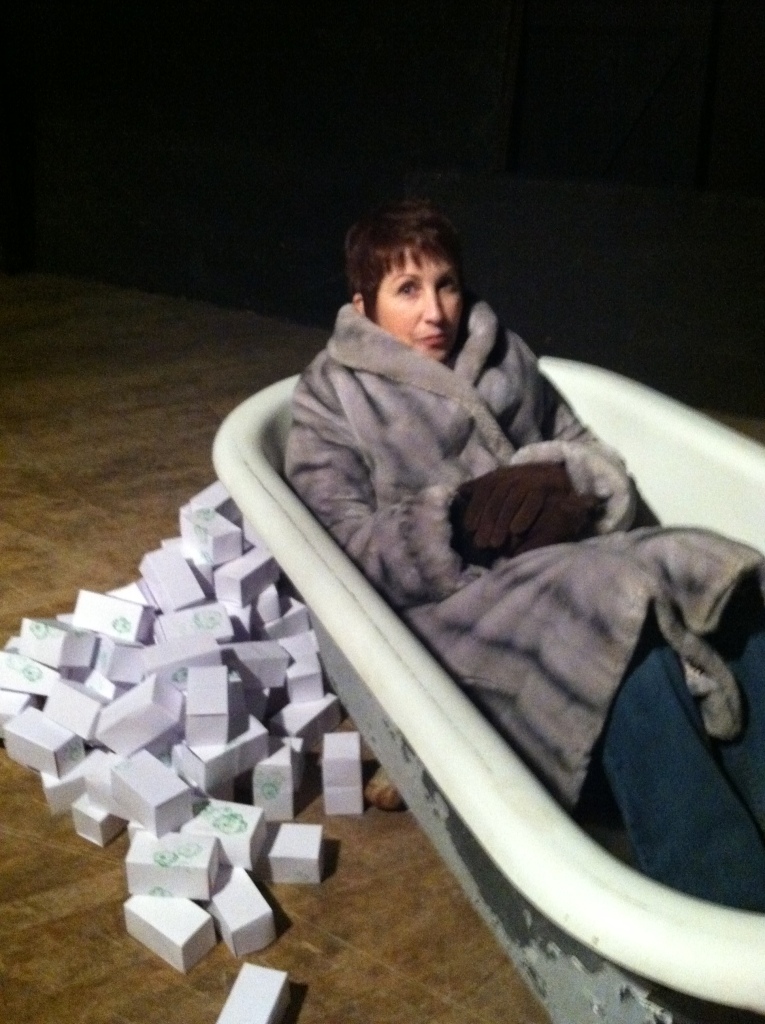
Wrapped in my fake fur coat, sitting on a heating pad in the bottom of the clawfoot tub in the unheated Feed & Grain in Loveland, CO. I found the tub on site while scouting the building for the place I wanted to create the installation.


Two images of the clawfoot tub with piles of origami boxes, (a nod to the Japanese woodblock print images that inspired MMP), surrounding the tub. The boxes are stamped with images of Spade foot toads. The stamps were fluorescent green, referencing the Pearls of Trinity – globs of green glass created from sand after the Trinity test in ’45. Each box contained a pink tissue paper glitter star with a line of info from the pinkStardust Timeline written on it. Visitors to the installation were invited to take a box – the pile dwindling with each box removed.
A ‘satellite installation’ (a category I’ve created for work orbiting but not a part of pinkStardust), “they sang before the dawn…” was my response to something I found while researching for pinkStardust. It wasn’t much, Just two or three lines in a book about J.R. Oppenheimer.1
The book was American Prometheus: The Triumph and Tragedy of J. Robert Oppenheimer by Kai Bird and Martin J. Sherman (the one that inspired the current hit film Oppenheimer). In it the authors are interviewing Oppie’s brother Frank about his experiences on the night of July 16, 1945, while waiting for the Trinity test to begin.
Frank was located not many miles away from the test site, in a field office. He’s recalling the terrific rain storm that took place during the night before the test. He tells the authors that even without the noise of the storm he would not have been able to sleep that night because of the mighty racket going on. It seems the valley had filled up with frogs during the storm – their croaking echoing off the mountains, creating a terrific noise that could not be silenced.
Intrigued by Frank’s story about this burst of noisy life intruding on what was soon to become a valley filled with a tremendous roar and consuming fire, I contacted The University of New Mexico, Albuquerque to try and find out what was up. What were these frogs? I was told that the noise was actually made by Spade foot toads. The little creatures hibernate until it rains, then pop up to eat, procreate, lay their eggs, etc. I found a recording of the sound they make. It’s like little lambs baaing away.

I hid an old fashioned tape recorder in the drawer of a desk I used in the installation, referencing the field office where Frank was stationed the night before the Trinity test. It played Spade Foot toads croaking on a tape loop during the exhibition.
The toads croaked/baaed – until 5:29 am when Trinity dropped from the recycled forest service watch tower it was hanging from, incinerating everything within that ten mile radius.
Here’s a pic of one of the little guys. They use those feet to burrow into the earth backwards until all you see are those big eyes before they disappear underground.

From inspirational prints to actual material
The evolution of the four Japanese woodblock print images from inspiration (‘skin’ and “they sang before the dawn…”) to material (pinkStardust) is a good example of how my artistic process works. Non linear in thought – things connecting with other things. Tangled per se, but then presented in linear matter, reflecting back how we exist in time and space. This couldn’t be expressed more clearly than in the structures in both form and content of pinkStardust.


A bit about process
Creating an installation is not typically spontaneous work for me. This has been particularly true for the three installations that make up MMP. They all require a lot of thinking, a lot of research and a lot of tangling together of both free and purposefully connected associations before I begin making either forms or images.
Thus, the gift of spontaneity doesn’t generally show up in my process until I am actually creating the elements that will form, and inform, the installation. As with any artwork the material and the muse both have something to say about it once my hands begin making. And when creating the installation itself, in its space (placing elements and adding the surfacing, sound, lighting…), I always leave time for response – because sometimes the site has something to say about it, and I need to heed what is being said or the whole installation suffers.
My Manhattan Project
In this posting I related how My Manhattan Project was born and evolved from one installation to three. “skin”, the first in the series, (exhibited in 2001) -contrasting and comparing elements and events of our war with Imperial Japan (WWII), ending with the dawning of our atomic age.
The third installation in the series, called NUMEC: destroyer of worlds, is a more personal examination of our atomic history. It is about the uranium processing plant where my father worked after returning from fighting in WWII. After surviving two injuries in the war (shot and blown up), for which he received two purple hearts and a Bronze Star, he was irradiated during his time at NUMEC, never felt well again, and died from the cancer it caused some years later. NUMEC: destroyer of worlds is in the development stages and will be exhibited sometime in the future.
Then there is the second in the My Manhattan Project series. The installation that, as the title of my blog states, I am actively searching for both exhibition space and scheduled exhibition time – somewhere on or near the dirt where most of the story took place. pinkStardust.
In pinkStardust I continue my examination of our atomic history by focusing on the testing times (roughly 1945-1970) – the height of atomic tourism and the strange dichotomy used to keep us both fascinated and terrified.

Next Time
In future postings I’ll continue to talk about creating pinkStardust – the themes, organizing structures, elements I’m making, and the tangles of people and events. Future posts will go into more detail about specific pieces, like The Four Enola Geishas – the appropriated images of the Japanese woodblock print images discussed above, that I reworked to help tell the story of pinkStardust.
 carlisle studio