pinkStardust: my search for time and space

pinkStardust is the second sculptural installation in my series exploring our atomic age that I call My Manhattan Project.

In it I illuminate the strange dichotomy that existed during our atomic testing times.

An idea for a pin, available for sale at the installation site gift shop.

It was called The Cold War, spanning the years between the end of World War Two and the fall of the Berlin wall. It was the time when children were trained to duck and cover by a cartoon turtle called Tommy and told not to eat the snow (as it contained nuclear fallout from the atomic testing being conducted in the Nevada desert, 60 miles northeast of Las Vegas). It was the time that our parents were urged to build a backyard bomb shelter in order survive the coming Armageddon threatened by the USSR at any moment.

But, in the meantime, we ate atomic-themed food, wallpapered our new hip pads with atomic-themed imagery, drank atomic cocktails and danced to atomic music.

Just as those who lived through the insanity and carnage of WWI responded with an art movement called Da Da, danced to hot jazz and drank bathtub gin, so we went a little Pop with the atom and it’s glowing possibilities for good, evil and the “That’s all folks” potential of world annihilation.

My goal in creating pinkStardust is not to judge past decisions made by folks living in a different time, in a different context. What I am doing is shining a spotlight on our past, hoping that we will make contact with those decisions and perhaps plot a future course with the atom that is not destructive, but instead, full of positive potential.

I wonder. Will our choices be different?

Copper cut out of a peace crane. Detail of Wind Chime, originally exhibited in my first My Manhattan Project installation, skin in 2001.
pinkStardust: my search for time and space

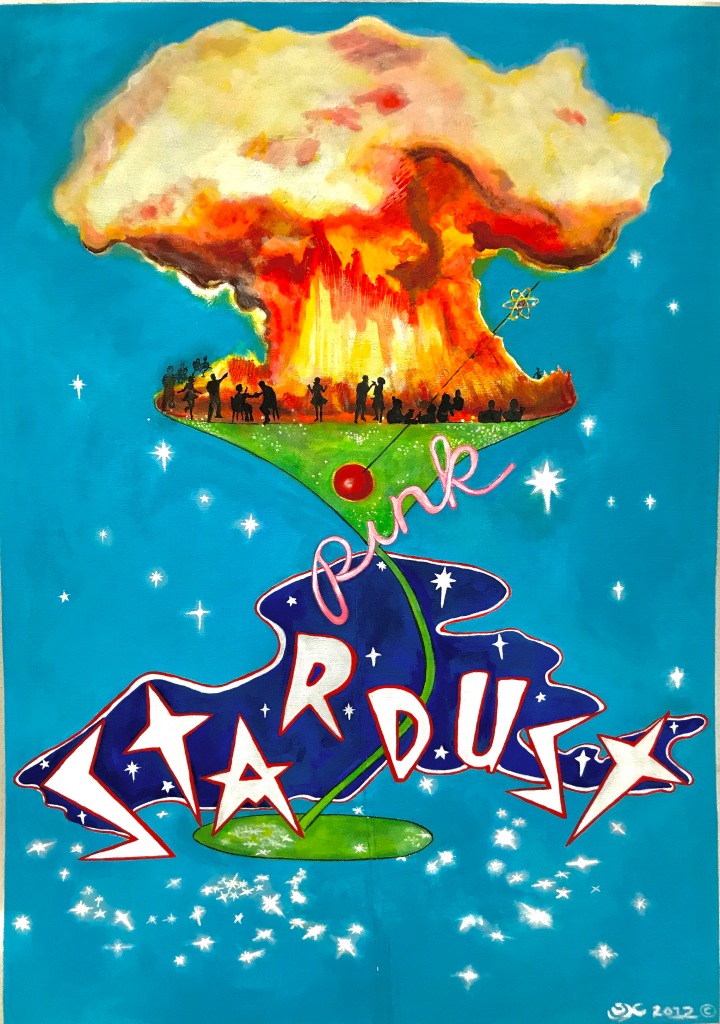
Acrylic paint on scarred canvas, mended with medical tape. 2012

Poster for pinkStardust – created by hand, as it would have been “back in the day”.

pinkStardust: my search for time and space says it all – I’m looking to secure an exhibition space and schedule the time the installation will be available for visiting. I am also searching for the curator who will work with me on the project. Someone as fascinated by this epoch of time as I am (the heyday of our atomic testing times).

As I continue the search for the time and place pinkStardust will exist as a completed installation, I continue to make the work. Future posts will be about the different components of the installation: objects, images, surfacing and lighting; the processes I am using; how the concepts for the installation express the overall content.  

I am also working on the practical: how the installation will be transported to its exhibition space, and the development of the video that will market the installation (featuring The pinkStardust Blues). Blog posts will be mined for book content.

Some blog posts will include past works orbiting the three installations that make up My Manhattan Project (skin, exhibited in 2001, pinkStardust and concluding with NUMEC: Destroyer of Worlds). I call the orbiters ‘satellite’ pieces. They include installations, objects and imagery,

And finally, I am making The 32 Most Notorious Atomic Tests (a series of works inspired by Warhol’s series 32 Campbell’s Soup Cans, 1962) that will be auctioned off to fund materials and supplies for pinkStardust. Andy is a big part of pinkStardust both in content and inspiration so I will be talking more about him in future posts.

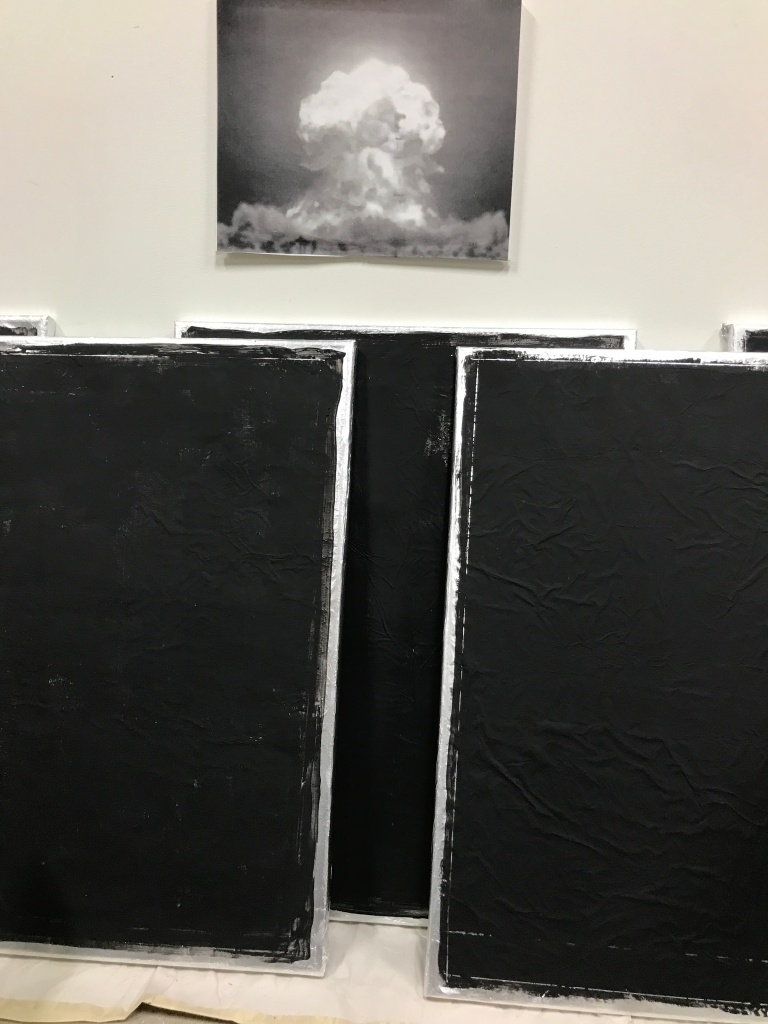
Prepared canvases, (16″ x 20″,  the same size canvases Warhol used for his 32 Campbell’s Soup Cans series).  Skinned with the back side of aluminum foil (a nod to the original Factory and a material that I am using in work for pinkSardust), coated in black acrylic paint, and awaiting the drawings of notorious atomic tests from the time frame that pinkStardust sits in – 1945 to the present with a focus on the 1960s.  

The image taped behind the canvases, on my studio wall is a black & white copy of Trinity, the first ever atomic explosion. That first test will have two drawings representing the event – one at an earlier stage of explosion and this one of the mushroom cloud that developed.

I strongly desire to exhibit pinkStardust somewhere in the southwest, preferably close to the “dirt” where the events I am discussing in the installation took place, such as: 

New Mexico. Los Alamos, the site of Trinity, the first atomic explosion that started it all, as well as one of the current locations for nuclear weapons testing, White Sands Proving Grounds. 

Nevada. Las Vegas when it was known as the Atomic City because of the many above ground atomic tests that were conducted about 60 miles north – prompting ‘bomb parties’, family picnics, and other atomic tourism.

Los Angeles, where museums such as the Wende exhibit work about the Cold War.                    

Or, someplace out there that is looking for me too.

Art vs Artifact

How I look at the context we use to interpret our objects at the Loveland Museum 2021

Sharon Carlisle’s installation at the Loveland Museum, Speaking to Water, January 21 through August 28, 2021, inspired a thoughtful dialog about Art vs Artifact that has influenced how I look at the context we use to interpret our objects at the Loveland Museum. The Museum exhibits both history and art allowing crossover interpretation to occur. The ability to use art as a form of interpretation in a history gallery is unique and makes visitors pause a moment longer to decide how they are reacting to a theme interpreted through an artist’s lens. This is, perhaps, a more emotional level of interpretation than the straightforward text describing events, materials, and use that usually accompanies a history exhibition. Using the artist’s viewpoint is more akin to storytelling. Allowing an artist to share their view of the world with the visitor. Sharon’s artwork utilizes the idea of art vs artifact. Her use of actual historic artifacts and themes as inspiration is evident.

An artifact can be defined as the product of skilled craftsmanship. Artifacts inform us about past events and about how previous cultures lived and built their communities. They are the evidence left behind by people living their lives. Art, by this definition, can also be an artifact.  What separates art from artifact is often the emotional and esthetic quality that reaches beyond the everyday use of the object. So, when does the artifact become art? Sharon Carlisle reaches a balance in her artwork between art and artifact. She discovers artifacts, such as the 1920 workbench featured in her Speaking to Water installation, and transforms them into art. Her artwork becomes an artifact of her own body of work. Used originally as a part of another installation, Tended Primitive Emergence, the table changes meaning as it is used in a different context to show the history of the development of The World Wide Water Project. This change from art to artifact does not mean that the element of art is removed from the piece.  It just gains additional meaning as the artwork moves through time into different spaces. 

The older the art work becomes, the more of an artifact it also becomes. Likewise, as an object moves through time, its context as an artifact becomes more valuable and creates an art-like quality to its interpretation. Think of an archaeologist digging through the layers of an ancient culture. Archaeologist find and assign cultural value and interest to the remnants of daily life. Even today, we produce so much disposable material culture. Broken handles or pots, scrap metal, and plastic. These are the things that future archaeologists will discover and will utilize to reconstruct our culture. Imagine assigning a value and meaning to a broken dinner plate. Will that plate become as elevated as a reconstructed Etruscan vase as time passes? 

Artwork and artifacts are also assigned value by the individual interacting with the object. An artifact placed in the right context has the potential to portray emotion and esthetic. Artifacts can be as inspiring to a viewer as artwork is meant to be. Artifact can be the basis or inspiration for an artist’s creation further elevating the value of the everyday material culture and blurring the line between what is the art and what is the artifact. It is hard to distinguish where the line between art and artifact should be drawn. The line, for me, is blurred more and more as I think of what I have collected for the Museum in traditional categories. Maybe it is not for me to designate what an object is but, rather, the object should speak for itself inspiring the viewer to make the decision depending on the lens in which they are looking.

Jennifer Cousino, Curator of History

Loveland Museum

Words

Touch Feel Hold Explore

Edited for publication 11/10/222

PLEASEtouch.

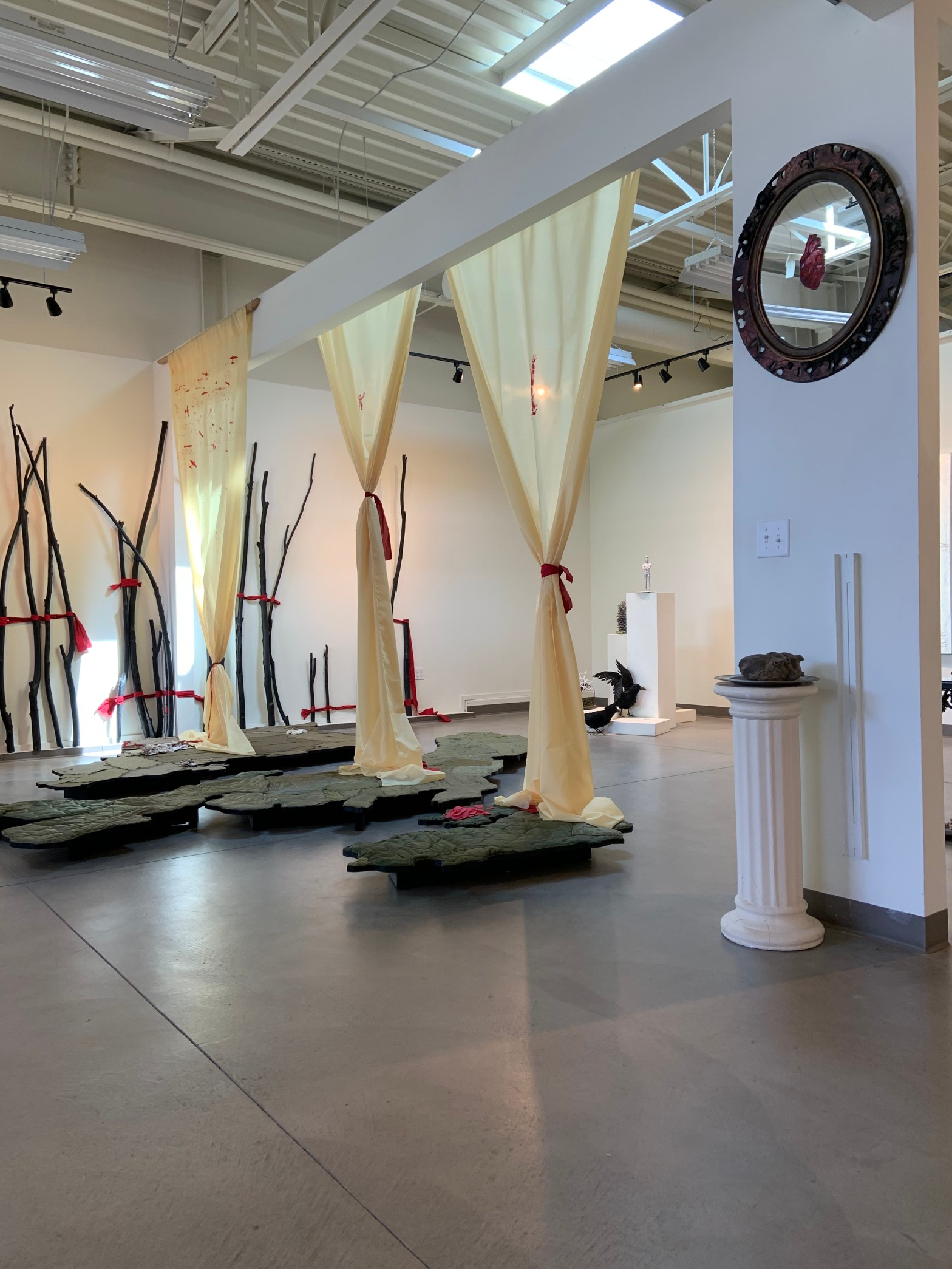
Along with senses of sight and sound, I invite visitors to expand and focus their present awareness by using their sense of touch, a gesture seldom allowed in museums and galleries. The installation encourages visitors to move in and out of time through my inclusion of elements of past (artifacts from past installations), present (new work and reworked artifacts) and future (referencing what’s to come).

Upcoming posts include guest essays That Objects Have Energy by Jennie Kiessling (artist and educator) and Art vs Artifact by Jennifer Cousino (Curator of History at the Loveland Museum/Gallery in Loveland Colorado) along with a 5 question interview of me by Bhanu Kapil (experimental writer, poet and educator).

I have posted images from the installation with accompanying discussions about the histories of objects, surfacing and materials used along with informative bits.  I hope you continue to join me in my broad investigation of touching, time, current awareness and experiencing the then and now of it.

 PLEASEtouch was exhibited at Artworks Center for Contemporary Art’s (ACCA) north gallery at 310 N. Railroad Avenue, Loveland, CO from September 10 – October 30, 2021

Artist’s Talk is available for on Youtube at:https://www.youtube.com/watch?v=acZVRNDvyVY&t=803s

A big thank you to Artworks Center for Contemporary Art for inviting me to exhibit PLEASEtouch and for facilitating my Artist’s Talk about the installation and its place in my body of work.